
Here's a confession: I watch a lot of videos about AI operating systems. Some in the background while I work, some twice with notes open. Over the past few weeks I saved 30 of them, from 18 different creators, and had my agents turn them into notes I could search.
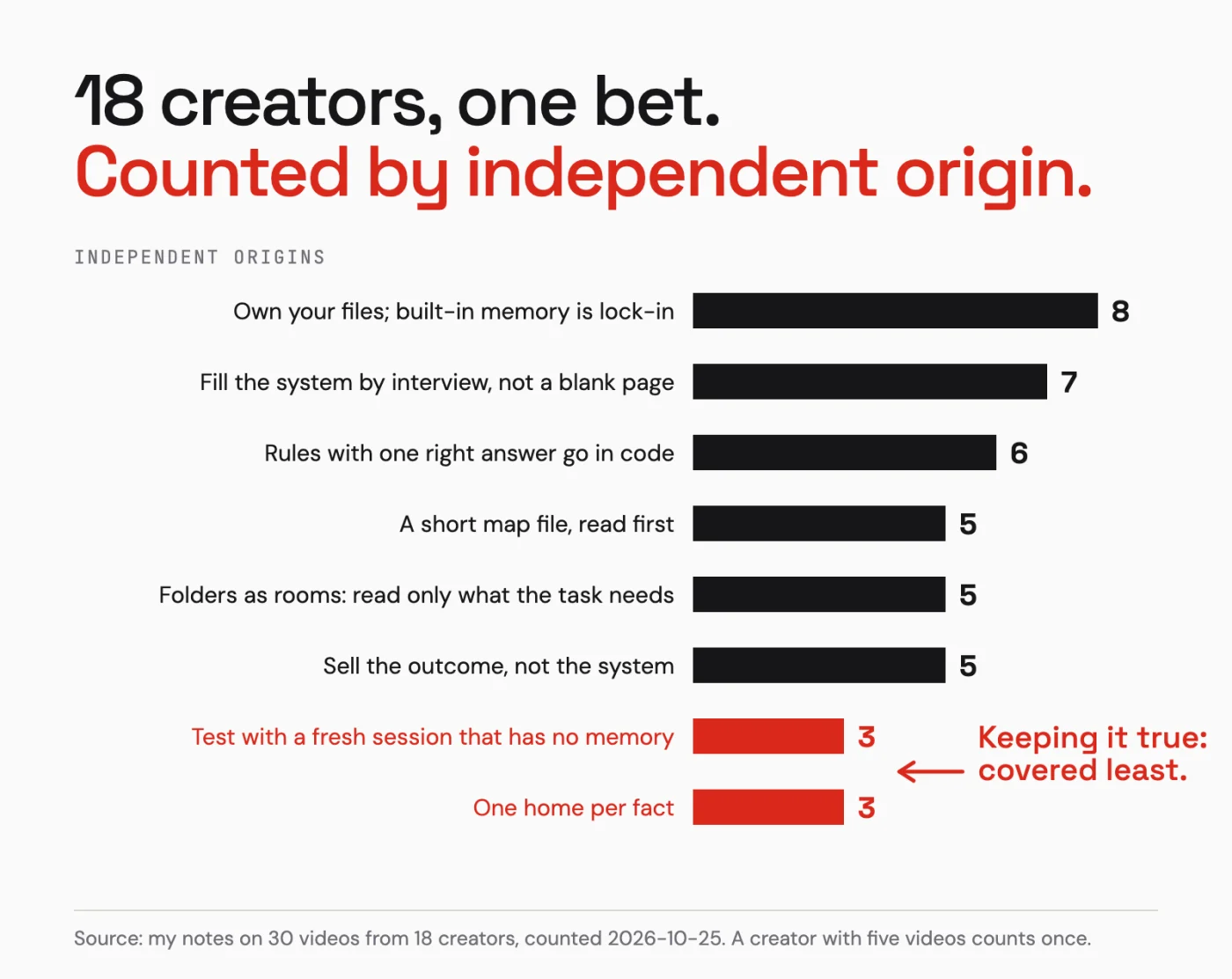
Then I asked a simple question. What do all these people actually agree on?
The answer surprised me. Underneath the different names, tools and thumbnails, almost everyone is making the same bet.
The bet#
An AI is only as good as the plain-text folder it wakes up into.
That's it. Your knowledge lives in simple files you own, a short map tells the AI what exists, and the AI reads only the room it needs for the task in front of it. Different creators call it a second brain, an agentic OS, a knowledge base or a workspace. Same bet.
Here are the creators who shaped how I think about it, and the moment in each video that stuck with me.
- Jake Van Clief makes the case that you can stop building one agent per task and let one AI take the shape of whatever folder it's in. That idea changed how I organize everything.
- Nate B Jones explains why built-in chatbot memory works against you when you switch tools. Owning the files is the whole point.
- Jay E (RoboNuggets) keeps the instructions file short and treats it as a router, not a manual. Mine was too long for a while. He was right.
- Nate Herk offers a test I love: does a brand-new session answer like a teammate or like a stranger?
- Nick Saraev points out that an AI treats old and new facts as equally true unless you date them. Small idea, big consequences.
- Eric Michaud separates the files a human writes from the files a machine writes, and keeps the AI's hands off the human side. Simple, and very smart.
If you only watch one, pick the one closest to your own pain. Every one of them taught me something I now use.
Why it caught me#
Keep in mind that I didn't start from these videos. I started from frustration, explaining myself to a new chat over and over, and slowly built my own way of working out of folders and plain files.
So watching 18 people arrive at nearly the same place felt like a relief. It meant the idea wasn't just my quirk. When this many people, working separately, land on the same shape, the shape is probably right.
It also showed me something about where this is heading. The folder structure itself is becoming common knowledge. Several of these creators give theirs away for free. That's great for everyone, and it tells me the folders alone aren't the hard part.
Where my working method adds a habit#
So what is the hard part? For me, it's keeping the whole thing true over time.
Building the folder takes a few short sessions. Keeping it honest takes a habit. A few of these creators name the problem directly: Nate B Jones shows how a neglected summary drifts and starts reading as confident truth, and Jake Van Clief caught his own files describing an old format while recording. I've been there too.
Here are the three habits I lean on most, the ones I see covered least:
- Hand off on purpose. Every working session ends by writing down what changed and what's next, so the next session, with any AI, starts from the file instead of from me.
- A second check. The AI that builds something never grades its own work. A different one checks it.
- One home per fact. A decision lives in one file. Everywhere else just points to it, so there's nothing to drift.
None of this is exotic. It's closer to keeping a kitchen clean than to building one. But in my experience, it's the difference between a system that's impressive in month one and one that's still useful in month six.
Worth your time#
If you're starting out, Jake Van Clief's folder video is the clearest way in. If you already have a setup and it's getting messy, start with Nate B Jones on drift. And if you want the deeper version of why your AI forgets you, I wrote about that here.
I'm still learning from all of them. If there's a creator I should add to my list, I'd love to hear who.